
Laravel agency in Stuttgart
Laravel applications you can still change in three years
We build line-of-business applications and API backends with Laravel. For companies that will still want to change something in three years without anyone holding their breath.
A direct line
Three extensions, and behind them the people who know your project. No switchboard.
Built to hand over
Versioned migrations, and tests where a mistake actually hurts. Another team can pick this up later.
Room to grow
Backends that keep no state in the process. When load rises, you add instances.
No third-party scripts
This site loads nothing from anyone else. That is why there is no cookie banner on it.
Services
What we do with Laravel
From the first line of code to the day-to-day running of it. A good part of our work, though, is projects that already have a history by the time we arrive.
Laravel development
Custom applications, from the first workshop to day-to-day operation.
APIs & backend development
Stateless REST and JSON APIs behind web front ends, apps and other systems.
Migration & upgrades
Version jumps, replacing legacy systems, moving onto Laravel.
Maintenance & support
Updates, monitoring and a named contact for applications already running.
Emergency & urgent help
Urgent help when an application is down, has been broken into, or stopped working after an update.
Consulting & code audit
A second opinion on architecture, code quality and security.
Why Laravel
Structure you can still follow a year later
Laravel settles where each kind of code belongs. Input checks live in the request, long-running work in a job, the output of an interface in a resource. A team does not have to negotiate those questions again on every project.
Software is rarely expensive to build. It gets expensive two years later, when someone has to change one small thing and first spends a week working out why it was built that way. No technology fixes that. Only the discipline to keep tidying up as you go. We hold to it from the start, even when it looks like a detour in the first month.
app/Http/Controllers/RechnungController.php
public function store(
    InvoiceRequest $request
): JsonResponse {
    $invoice = Invoice::create(
        $request->validated()
    );

    SendInvoice::dispatch($invoice)
        ->onQueue('mail')
        ->afterCommit();

    return InvoiceResource::make($invoice)
        ->response()
        ->setStatusCode(201);
}
How it fits together
One path, and always the same one
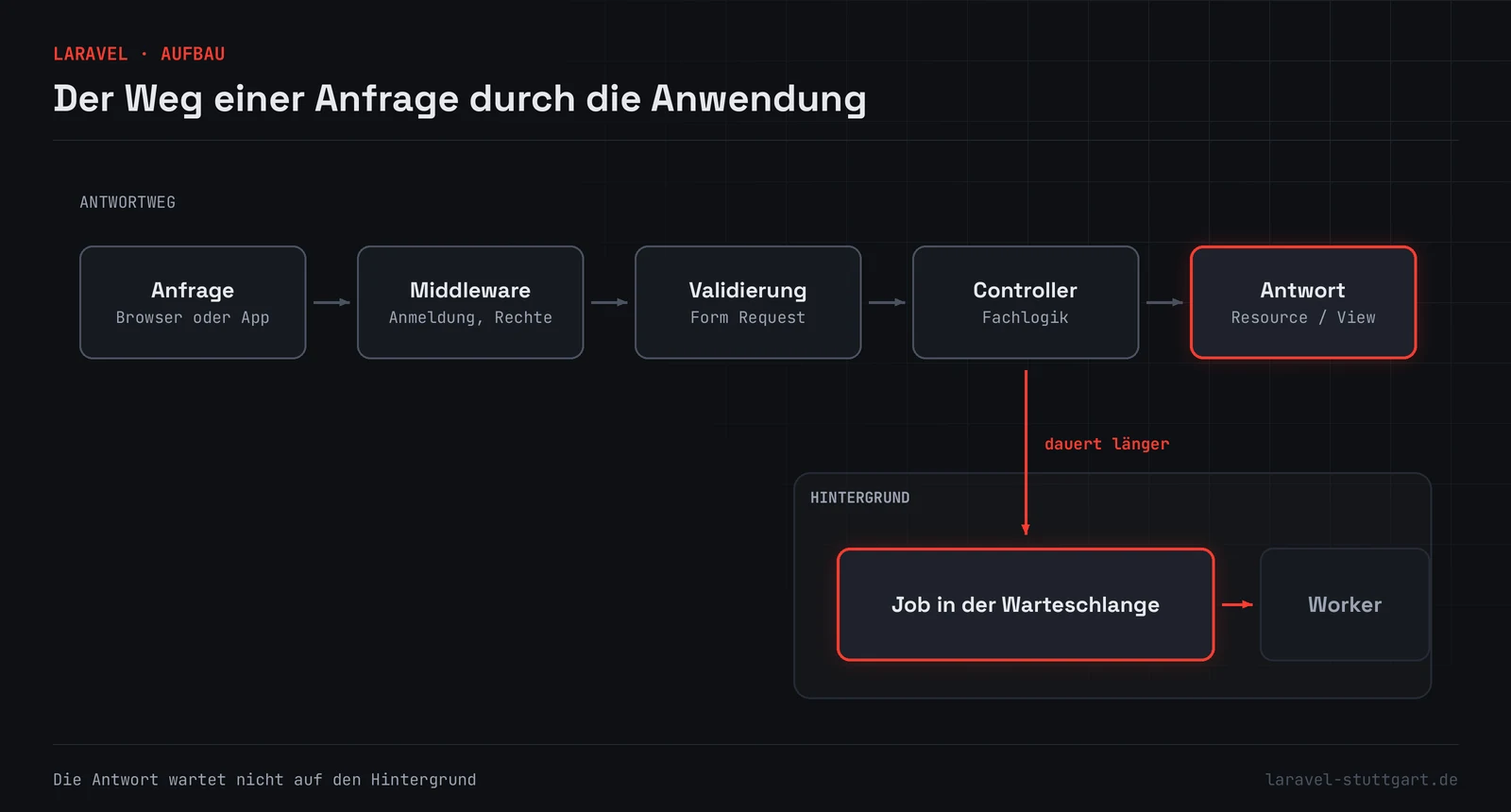
Every request takes the same path. Middleware checks who is asking and what they may do, a request object validates the input, the controller does the actual work, a resource shapes the answer. Anything that takes longer moves into a queue and carries on in the background.
Painting by numbers, admittedly. But six months later, whoever has to change something knows straight away where to look.
How we work
How a project runs with us
A conversation
We listen, we ask, and we say so plainly if we are not the right people for what you have in mind.
Concept and estimate
We settle the subject matter and the data model. Out of that comes an estimate in which you can see which part causes which effort.
Building in steps
Short stretches, and something works at the end of each. You see early what is taking shape and can change course while that is still cheap.
Handover and operation
Deployment and monitoring are in place, the documentation is written. After that we take on maintenance, or hand over to your team.
Insights
From our work
What keeps us busy on projects, written for people who have to decide without writing the code themselves.
5 Sept 2026
Changing supplier without losing the application
A handover rarely fails on the code. It fails on credentials nobody holds and knowledge nobody wrote down. Six items and their pitfalls.
3 Sept 2026
Rebuild or repair: what works out cheaper on legacy systems
The answer does not hang on the age of the code. It hangs on whether the domain model underneath still holds. Three routes and what each needs.
31 Aug 2026
Technical debt, explained without the jargon
Why an application needs longer for the same change in its third year than in its first. And how to spot it without reading any code.
FAQ
Questions we get asked a lot
What does a Laravel application cost?
Do you take on existing projects?
Do you work on site or remotely?
What happens after launch?
Why Laravel rather than a website builder or a CMS?
Tell us what you have in mind
A few sentences are enough to start with. The person who answers works with Laravel themselves.