
Service
APIs and backends with Laravel
A backend serving several front ends needs clear contracts and must not hang off session storage. We lay it out that way from the first day.
One backend, several front ends
As soon as an application has more than one way in, the centre of gravity moves. A web interface, an app, perhaps a partner system as well. The business rules then belong in exactly one place, and every way in asks the same interface. Otherwise each channel grows its own set of special cases, and what is true about a record depends on who is asking.
Laravel brings the parts for this arrangement with it. Output is shaped by a resource, validation sits in the request, long-running work goes into jobs, clients sign in with a token. That is how we built the backend behind the fishing guide apps, for example.
Why stateless
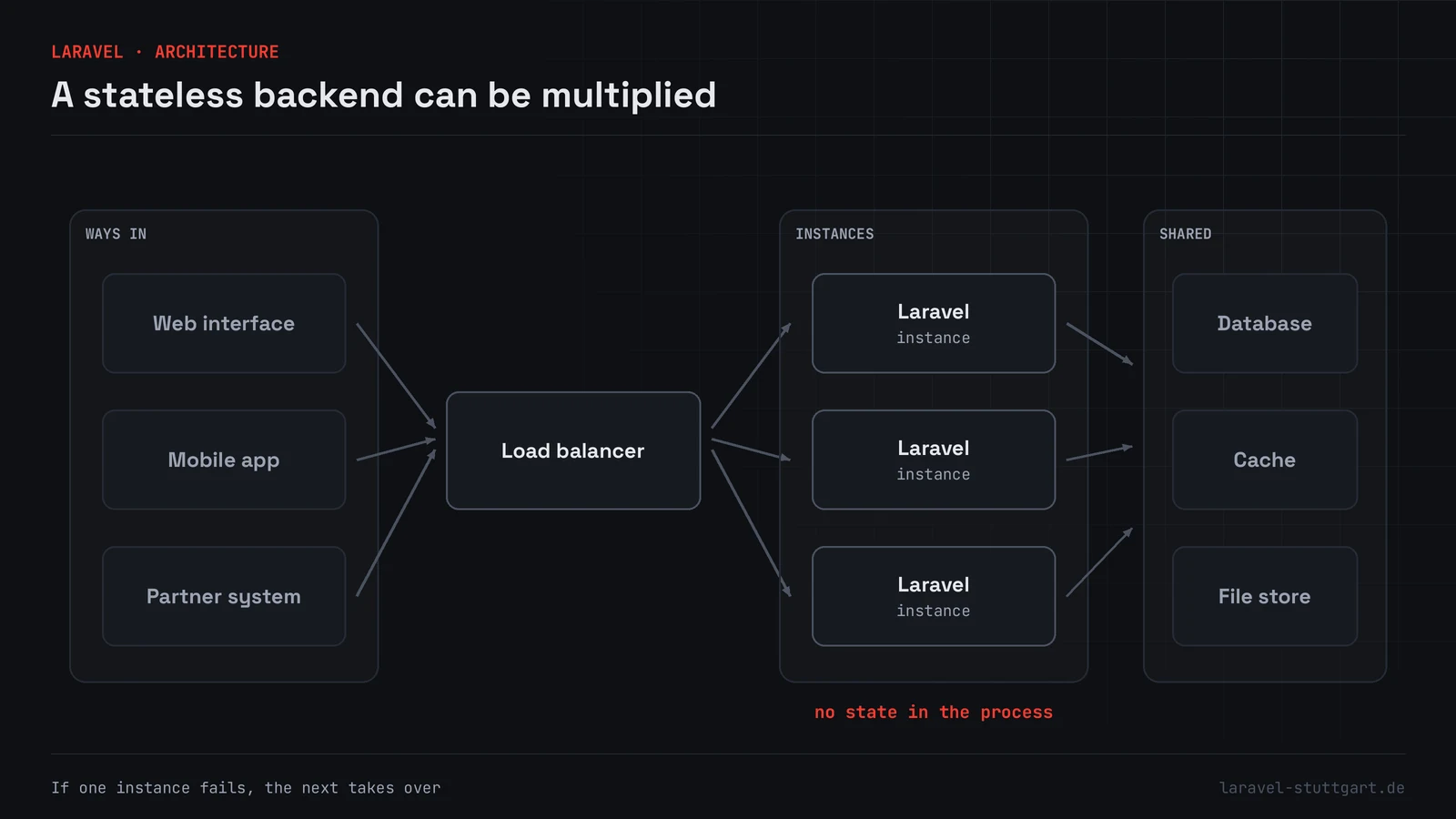
A backend that holds no session data in the process can run any number of times in parallel. If one instance fails, the next takes over and nobody notices. If load grows, instances are added. This is not a question of size, by the way. A small application benefits too, because a restart after deployment then no longer throws anyone out of their session.
It is paid for in discipline. Anything that has to survive between two calls belongs in the database or in a shared cache. Not in the memory of the process, and not “just for the test either”. Hold to that and you save yourself the rebuild later.
Integration work: ERP, inventory and other systems
Most often our projects are not about a new app at all, but about the connection to something that has been there for years. An ERP, an inventory system, a payment provider.
An ERP integration is rarely a technical problem. The question that costs time is a business one: which system owns a record, and what happens when both sides change it at the same time? Decide that too late and you end up with two truths, and you notice at stocktaking. So we settle ownership explicitly, field by field where necessary, before the first line of transfer code exists. Beyond that we work to a plain rule. The other system is unreliable until proven otherwise. Every call gets a timeout, every transfer a way to retry, every failure a trace you can still read three weeks later. What that looks like is visible in the travel portal under our work, which reconciles more than 150,000 places to stay every day.
More on how we take over existing systems is under migration and upgrades.
In detail
What a dependable API is made of
Stateless from the start
No state in the server process. That way the backend can be rolled out several times behind a load balancer without sessions going missing.
A clear contract
Fixed shapes for requests and answers, versioned. Whoever uses the API has to be able to rely on nothing shifting underneath them.
Authentication
Tokens for machines, sessions for browser front ends on the same domain. Which one fits is decided by the use case.
Queues
Sending mail, exports, calls to other systems. Whatever takes time moves into a job. The answer stays quick, however much runs behind it.
Errors and limits
Error codes that say something, a capped call rate, sensible timeouts. An API that simply hangs under load is worse than one that refuses clearly.
Documentation
A description another team can connect against without asking. Generated from the code, so that it does not go stale.
More services
You may also need
Laravel development
Custom applications, from the first workshop to day-to-day operation.
Migration & upgrades
Version jumps, replacing legacy systems, moving onto Laravel.
Maintenance & support
Updates, monitoring and a named contact for applications already running.
Emergency & urgent help
Urgent help when an application is down, has been broken into, or stopped working after an update.
Consulting & code audit
A second opinion on architecture, code quality and security.
FAQ
Questions about interfaces
REST or GraphQL?
Can you connect our existing front end?
How do you keep the API stable when something changes?
What about very heavy load?
Need a backend for several channels?
Tell us which clients are meant to reach it. The shape of the interface follows from that.