
Service
Laravel emergency: urgent help when the application is down
When an application fails, advice about architecture helps nobody. What counts then is somebody who knows Laravel looking at it, and working in the right order.
What this page is for
For the case where something is not working right now. Not for the question of whether a rebuild would be sensible, and not for planning the next stage. The other pages cover those.
We have worked with Laravel for years and regularly take on applications other people built. That is why an emergency in somebody else’s code is not a special case for us.
The order we work in
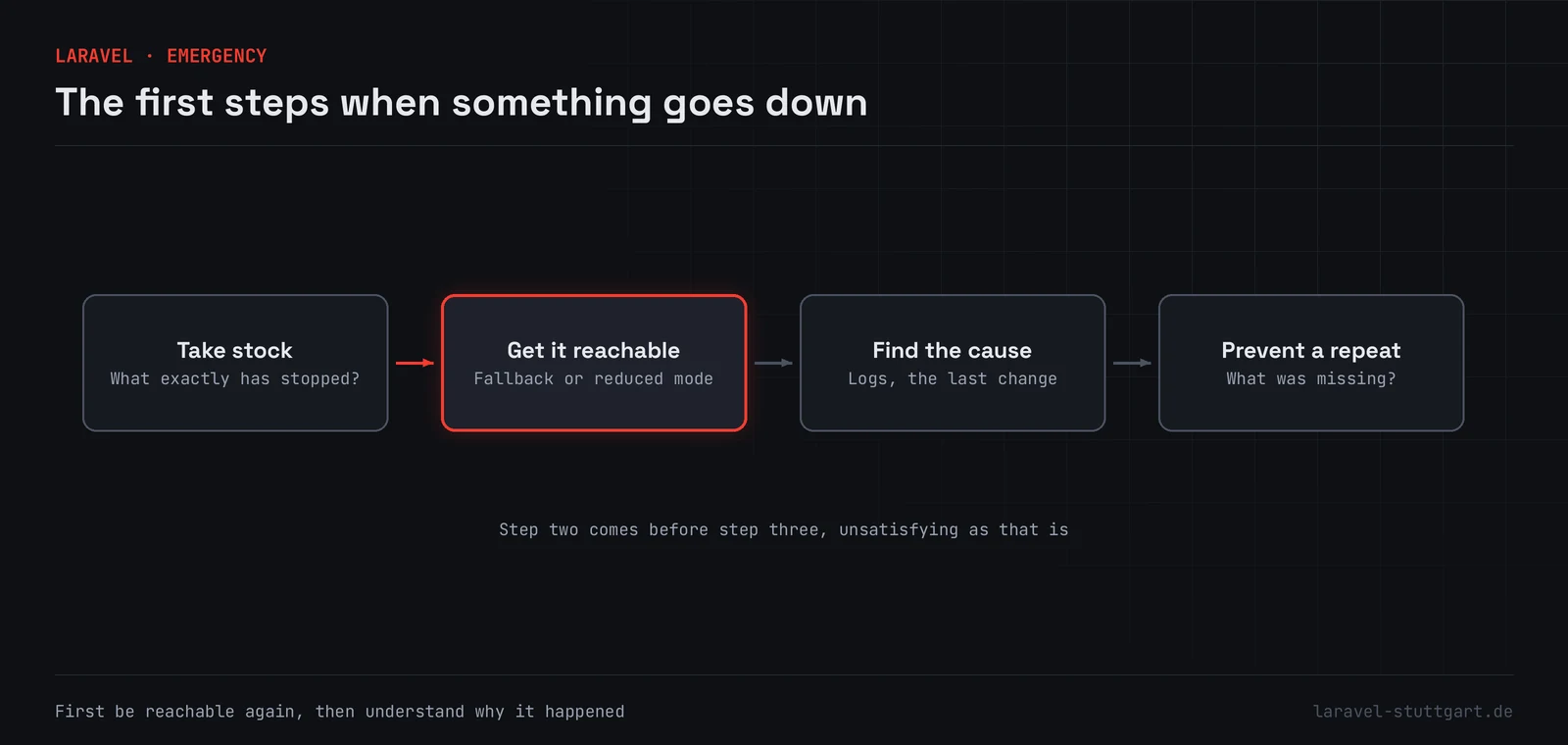
First we take stock. What exactly has stopped, since when, and what changed beforehand? The last change is the cause in the great majority of cases, and asking about it often saves hours.
Then we make the application reachable again. That is deliberately the second step rather than the last. Falling back to the last working state, or running in a reduced mode, is unsatisfying because the cause has not been found yet. For your business it is the difference between an hour and a day.
Only then do we look for the cause, calmly and on a copy rather than on the running system. Logs, the last deployment, the changes to dependencies.
And finally the question of how it got that far. Nearly always something small was missing: monitoring that would have spoken up earlier, a verified backup, a rehearsed way back. Many people skip this last step, which is why the next call comes.
What we need from you
The more of this arrives with the first message, the quicker it goes.
- Access to the server or the hosting account, and to the source code if you have it.
- A description of what does not work, ideally with the exact wording of the error.
- The point at which it last worked.
- What happened between that point and now. Small things count, such as an update at the host or an expired certificate.
- Somebody on your side who is allowed to make decisions.
If access is missing we still start. It simply takes longer, because obtaining it becomes the first step.
If it was a break-in
A compromised system needs a different order from a technical outage. The reflex to delete the unfamiliar files quickly is the most expensive mistake available: it removes the traces rather than the hole, and as a rule the attacker comes back the same way.
What helps is preserving the state before anything is changed, taking the application off the network, and treating every credential as exposed. Only then does the clean-up begin, and from a clean state rather than by deleting things in the running system.
Which holes usually sit behind such cases is in the piece on findings from security audits.
What we do not promise
No round-the-clock standby. A promise meant to hold at night and at weekends needs several people in rotation, and anything else does not survive contact with reality. During normal working hours we are quick to reach, and anyone who needs guaranteed response times settles that under maintenance.
Nor the recovery of data that no longer exists anywhere. What can be reconstructed is something we tell you after the first look, including when the answer is unwelcome.
Once an emergency is over, it pays to look soberly at what was missing. That is a software audit; it takes longer than the call-out itself, but it prevents the next one.
In detail
What you can come to us with
The application is unreachable
A white page, a 500, a timeout. Usually behind it sits an expired certificate chain, a full disk, or a service that never came back after a restart.
It broke after an update
A version jump in PHP, in the framework or in a package. The quickest route is nearly always back to the last working state, then the jump again, this time rehearsed.
Signs of a break-in
Unfamiliar files, redirects to other sites, warnings from the host. This calls for its own order of work, or the traces are lost.
It has suddenly gone slow
Often a query inside a loop, a missing index, or a queue nobody works off any more. It only shows under load.
Data is gone or wrong
A faulty import, an accidental deletion, a job that ran twice. First we preserve the current state, then we bring things back.
The previous supplier has gone quiet
Not a technical emergency, but a real one. What has to be settled is in the piece on [changing supplier](/en/insights/changing-software-supplier).
More services
You may also need
Laravel development
Custom applications, from the first workshop to day-to-day operation.
APIs & backend development
Stateless REST and JSON APIs behind web front ends, apps and other systems.
Migration & upgrades
Version jumps, replacing legacy systems, moving onto Laravel.
Maintenance & support
Updates, monitoring and a named contact for applications already running.
Consulting & code audit
A second opinion on architecture, code quality and security.
FAQ
Questions about urgent help
We are not a client of yours. Will you still help?
Are you reachable around the clock?
Our site was hacked. What is the first step?
We have no working backup. Is everything lost?
What does a call-out cost?
Is the application down right now?
Ring us, that is the faster route in this situation. Have to hand whatever access you hold and when it last worked.