
Service
Laravel development for line-of-business applications
Sooner or later the spreadsheet stops coping, and an off-the-shelf product still does not fit. That is when an application of your own comes in. It should follow the way you work, not the other way round.
When custom software is worth it
Not every problem needs software of its own. If there is an established product for your case, that is usually the cheaper answer, and we will say so.
Custom software is not a special way of building. It is a decision about the cut: the application is built for one way of working rather than for a market. What comes out of it is technically the same as something off the shelf — except that nobody else uses it, and that is exactly why it has to be handed over cleanly. Who owns the code, who can carry it forward and what a move away would look like: we settle that before the first working day, not on the last.
Building your own pays off where your way of working is the difference. A calculation nobody else does quite like that. An approval chain that belongs to your organisation and to no other. A connection between systems that no finished product covers. In cases like these, a standard tool forces you to bend your own process. That bill does not arrive once. It arrives every working day.
What Laravel contributes
Laravel takes the same recurring decisions off a team. Where does validation go? How does a task move into the background? What does the answer of an interface look like? For all of that there is a path already laid out. It sounds unremarkable, and it decides whether anyone can still find their way around the code two years later.
Then there is the ecosystem. For authentication, queues, file storage or schedules there are maintained parts that fit together. So we write what makes your business what it is, rather than a forgotten-password flow for the fourth time.
How we work
We build in short stretches, and something runs at the end of each one. You see where things stand in a test environment and can steer while that is still cheap. We prefer that to half a year of silence with a surprise at the end.
What we leave alone: taking on dependencies we do not need, building exotic constructions only we understand, making decisions and writing them down nowhere. An application only its builders can maintain is a risk for you. It would be comfortable for us, but you get nothing out of that.
In detail
What a project like this is made of
Cutting the subject matter
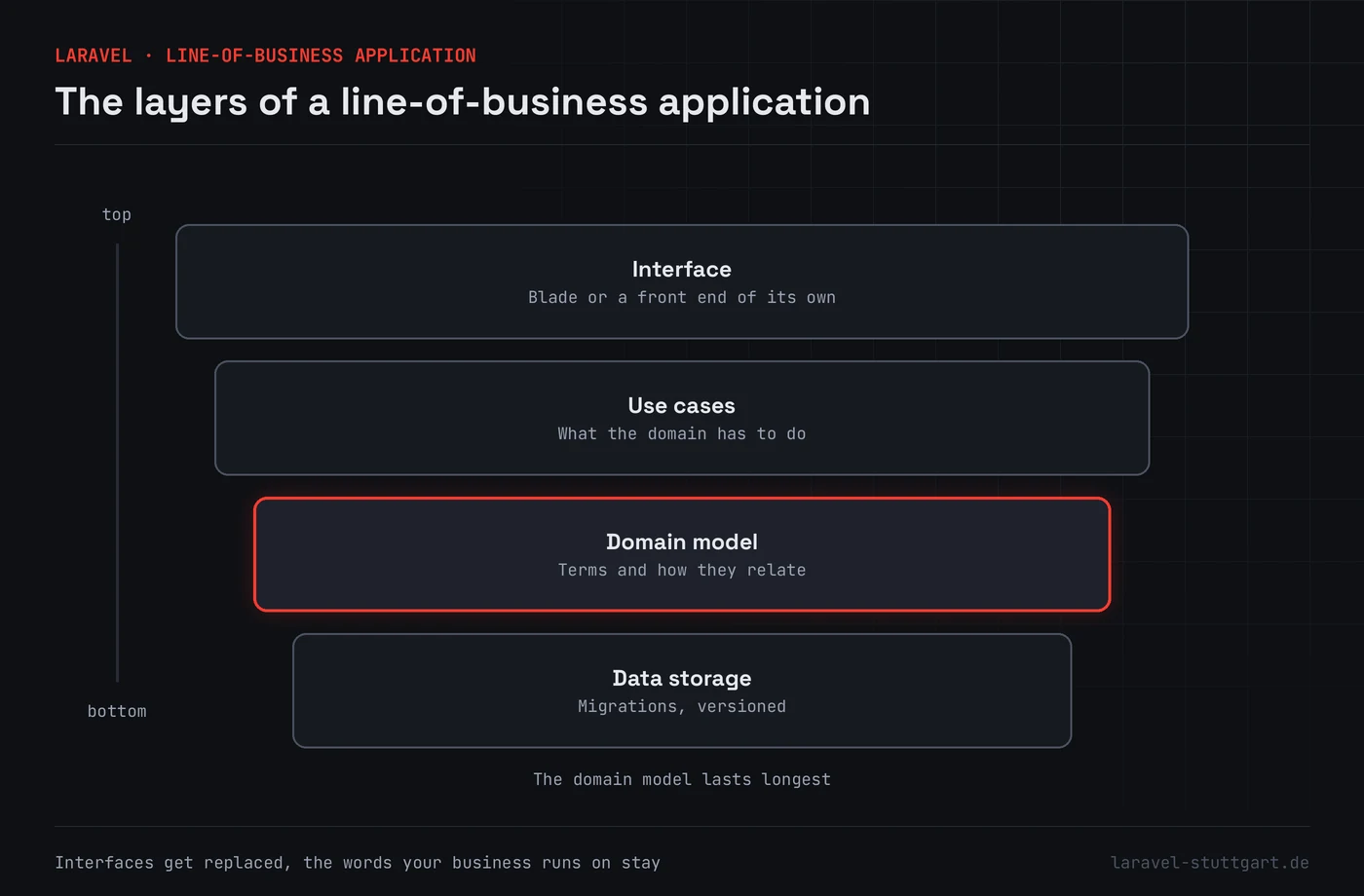
Before a line of code exists, we settle your terms and how they relate. That model carries everything that comes after it.
Data model and migrations
Every change to the database sits in the repository as a versioned migration. Any state can be traced and restored.
Roles and permissions
Who may see, change and approve what? Permissions belong in the foundation. Retrofitted into the interface, they never hold.
The interface
Rendered on the server with Blade, or a front end of its own against an API. Which way fits is decided by the use case, not by fashion.
Tests
Automated tests where a mistake hurts. Calculations, permissions, interfaces. The point is that someone can change something later without holding their breath.
Deployment
A repeatable route from development into operation, and the way back. Anything only one person can pull off by feel is not a deployment.
More services
You may also need
APIs & backend development
Stateless REST and JSON APIs behind web front ends, apps and other systems.
Migration & upgrades
Version jumps, replacing legacy systems, moving onto Laravel.
Maintenance & support
Updates, monitoring and a named contact for applications already running.
Emergency & urgent help
Urgent help when an application is down, has been broken into, or stopped working after an update.
Consulting & code audit
A second opinion on architecture, code quality and security.
FAQ
Questions about development
How long does a first release take?
Do we get the source code?
Can we carry on developing it ourselves?
Do you also work on applications that already exist?
Got a process that eats too much time?
Describe it to us in a few sentences. We will tell you whether an application of your own is worth it.