
Service
Maintenance and support for Laravel applications
Going live is where the longer part starts. Dependencies want updates, requirements shift, and sooner or later somebody asks why this used to be faster.
Why maintenance is not a side issue
A web application stands in the open internet and consists in good part of somebody else’s code. Every package can have a hole, and the advisories about them are public. Skip regular updates and you accumulate arrears. At some point the jump is so large that nobody wants to make it on the side any more.
The second reason is less dramatic and costs more money all the same. Applications nobody looks after go quiet slowly. A queue that has not run for weeks. An export that comes back empty. A certificate that expires. In house, that sort of thing usually surfaces only when somebody outside complains.
What monitoring is supposed to do
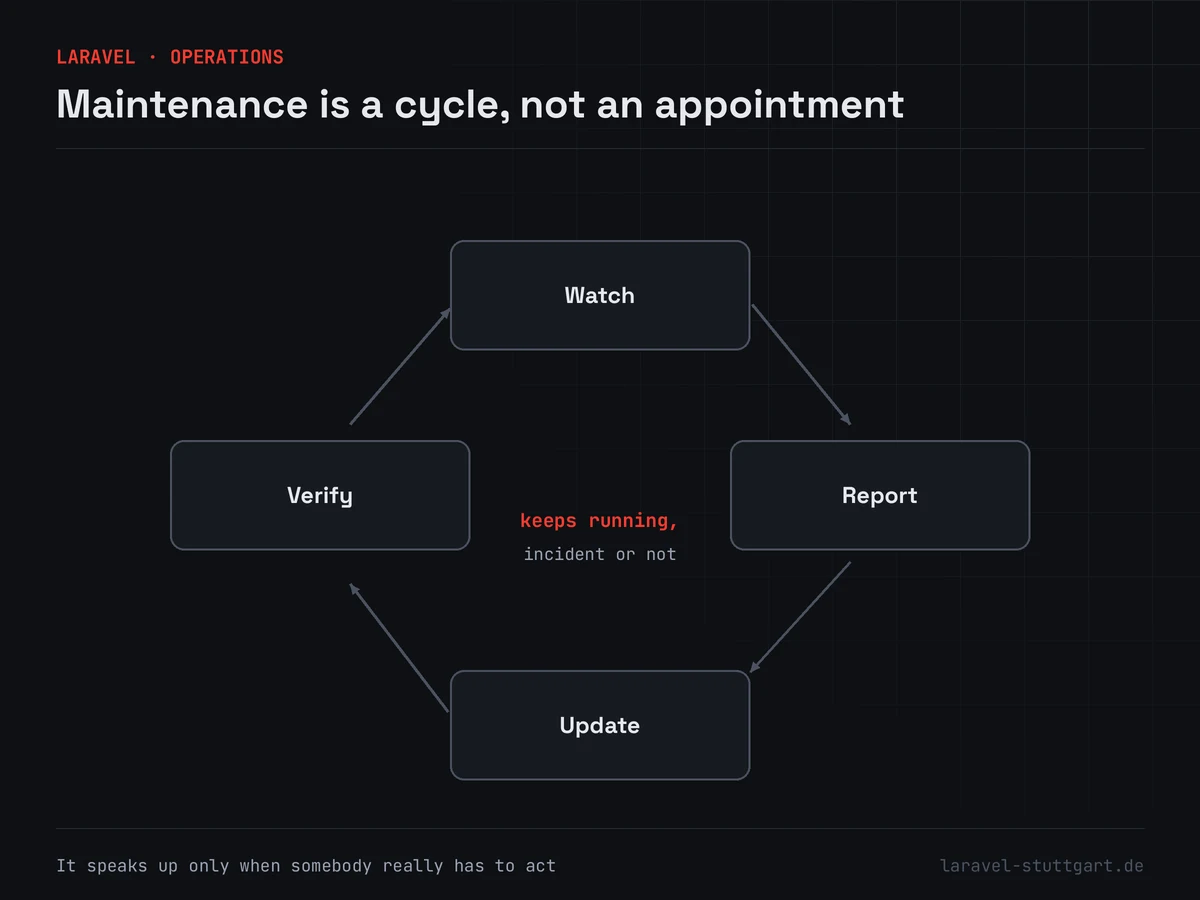
A dashboard nobody looks at is not monitoring. It becomes useful when it speaks up exactly when somebody has to act and stays quiet otherwise. We watch a few signals that actually say something. Is the application reachable? Is the error rate climbing? Are background tasks being worked off? Is storage filling up?
Alarms that fire constantly get ignored by everyone after a fortnight. So adjusting the thresholds is part of the ongoing work and not a one-off setup.
Backups that deserve the name
Almost everyone has backups. Whether a working system can be restored from them is something far fewer people have tried. That is the only test that counts. We restore backups regularly into a separate environment and check whether the application comes up there.
Two findings keep recurring. The database is backed up and the uploaded files are not. Or the backup sits on the same server as the application.
In detail
What we take on
Security updates
Keeping an eye on dependencies and putting fixes in promptly. One big jump a year is the more expensive option.
Version care
Keeping Laravel and PHP on maintained releases. Small steps taken regularly cost less than rare large ones.
Monitoring
Availability, error rates, response times, queues. We would rather not learn about a problem from your phone call.
Testing the backups
A backup that has never been restored is an assumption. We test the way back, not merely whether files are there.
Small changes
One more field, an adjusted report, a new recipient on a list. None of that is worth a project, and somebody still has to do it.
Named contacts
Your mail reaches people who know your application. Not a ticket system that eventually produces an answer.
More services
You may also need
Laravel development
Custom applications, from the first workshop to day-to-day operation.
APIs & backend development
Stateless REST and JSON APIs behind web front ends, apps and other systems.
Migration & upgrades
Version jumps, replacing legacy systems, moving onto Laravel.
Emergency & urgent help
Urgent help when an application is down, has been broken into, or stopped working after an update.
Consulting & code audit
A second opinion on architecture, code quality and security.
FAQ
Questions about maintenance and support
Do you maintain applications you did not build?
What happens when something is urgent?
Does this run on a fixed allowance?
Can we take maintenance back in house later?
Is your application running without anyone looking after it?
Then it is worth a look at its condition, before the first incident provides the occasion.